
Be committed to your goal, but don’t become a prisoner of your plan.
Imagine applying for thirty jobs without being invited to a single interview. What would you do next? Apply for another thirty? Spend longer on each application? Or examine why the first thirty did not lead anywhere?
If your applications are reaching the wrong employers, doubling their number may achieve very little. If they are reaching suitable employers but the recruitment processes are still ongoing, the same number tells us something quite different. Thirty applications describe the work you have done; they do not explain why it has not produced the result you expected.
Over twelve years in career guidance, I have helped more than 600 people into employment or education. One of the most important distinctions in that work is between a person who needs encouragement to continue and someone who needs help finding a more effective route. I would not give both people the same advice simply because neither has reached their goal.
A plan rests on assumptions, not guarantees
Every plan contains a proposition: if I do this, under these conditions, I expect that to happen. When it does not happen, we can respond by doing more of what we planned, or we can examine the proposition itself. Before I increase the effort, I want to know what gives me reason to believe that additional effort will make a difference.
In my book, Act and Achieve – Become Your Dream, I emphasise realistic planning, regular evaluation and adaptation. A useful evaluation starts by identifying the point at which the expected connection between the action and the result breaks down.
In a job search, for example, identifying suitable vacancies, communicating relevant skills and performing at interview are different stages. If your applications already generate interviews, rewriting them may not address the reason you are not receiving offers. You need to investigate the stage that is actually preventing the result.
I have learnt a similar lesson through developing AI-based products. It is possible to spend hours improving a functioning product without addressing how the people it was designed for will discover it. If hardly anyone in the intended audience has seen the product, the absence of paying customers tells me little about their willingness to pay. If relevant people see the offer but choose not to buy, I have a different question to investigate. More development is not automatically the answer to either problem.
Continuous Progress
I use this four-part cycle to describe how action can become a process of learning and adjustment. The name describes a commitment to continuous evaluation, not a guarantee that every action produces improvement.
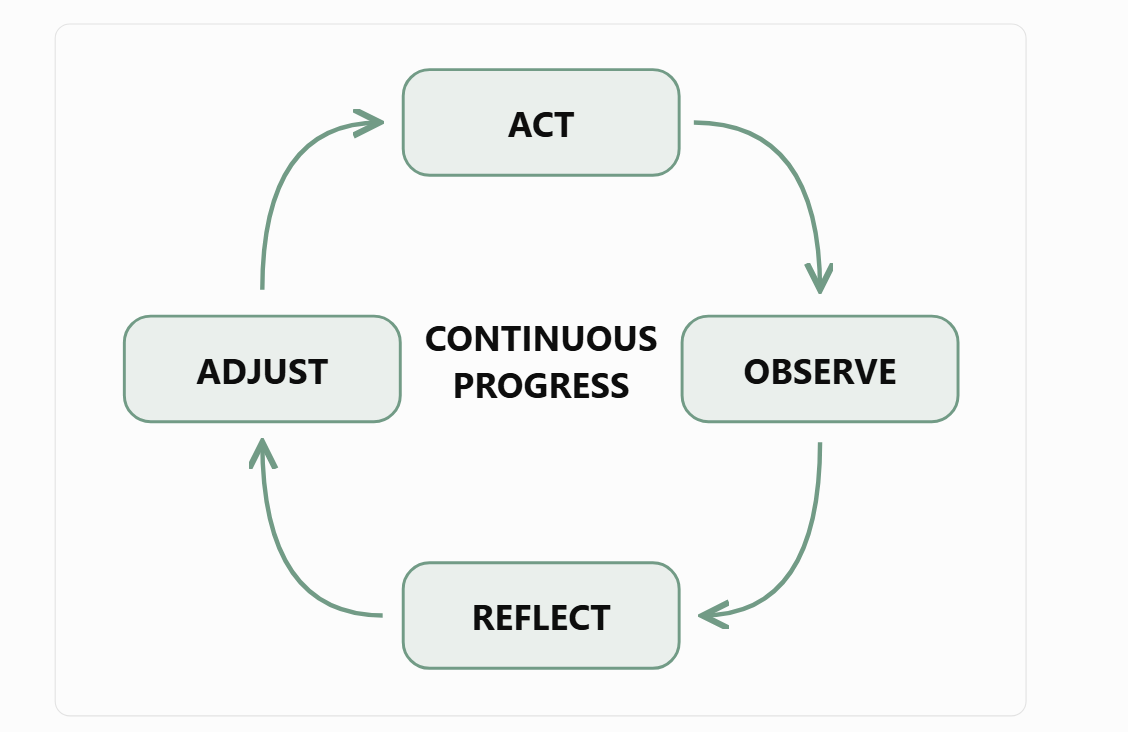
ACT. Carry out a defined action. Know what you expect it to achieve and what conditions it depends on.
OBSERVE. Record what you actually did and what happened in response. Keep the evidence about implementation separate from the evidence about its effect.
REFLECT. Compare the response with your expectation. Ask which explanations fit, which do not, and what information could help distinguish them.
ADJUST. Decide what to retain, change or discontinue. Where practical, test one important change at a time so that you can better understand its effect.
“I received no interview invitations” is an observation. “Nobody wants to employ me” is an interpretation. The same applies to our plans: “This has not worked yet” does not establish that it will never work. Equally, it does not establish that another attempt will succeed.
Specific feedback can help narrow the possibilities. In a 1996 meta-analysis, Avraham Kluger and Angelo DeNisi found that feedback interventions improved performance on average, but more than a third reduced it. [1] I would seek feedback that identifies something I can investigate: for example, which requirement my application failed to demonstrate. An opinion about my ability as a whole tells me far less about what I should change.
Time – Effort – Strategy – Purpose
The next question is what to change. I consider four possibilities: the strategy has not had enough time, it has not been implemented sufficiently, the method is unsuitable, or the original goal no longer fits the circumstances. More than one can be true. They are different explanations, not four interchangeable pieces of advice.
Imagine someone learning a language in preparation for a move abroad. They want to be able to hold everyday conversations. Below are four alternative situations for that same ambition. The observations, rather than the absence of fluency alone, determine which response is most reasonable.
| Consider | Evidence to look for | Next decision |
|---|---|---|
| TIME | Regular practice; everyday conversations are becoming easier, but the expected level has not yet been reached. | Continue the approach. Use a realistic learning timeframe and set a new review point. |
| EFFORT | Speaking practice helps when it happens, but only one of three planned sessions is usually completed. | Address the gap between planned and actual practice. Improve consistency or quality before judging the method. |
| STRATEGY | Practice is consistent, but consists mainly of written exercises. Understanding written words improves; conversation does not. | Test a method that includes actual speaking and feedback. Assess whether conversational ability changes. |
| PURPOSE | The planned move is cancelled. There is no longer a practical need for the original level of fluency. | Decide whether learning still matters for its own sake. If not, revise or release the original goal. |
The distinction between time and effort is particularly important. Time is a reasonable explanation when the method has had a fair implementation and the observations are consistent with the expected pace of development. Effort is a reasonable explanation when there is evidence that the method helps, but its implementation has been insufficient. An absence of results does not, on its own, establish either explanation.
There is no universal number of days or attempts that constitutes a fair trial. If the method has had a reasonable opportunity to work but the expected response is absent, look for a different explanation. The obstacle may be the method itself, an inaccurate assumption or an external condition you cannot change.
Purpose is not a verdict on how hard you have tried. If the circumstances that made a goal achievable or relevant have changed, changing the goal may be the rational response. Carsten Wrosch and colleagues’ 2013 review links the capacity to disengage from unattainable goals and engage with other goals to aspects of well-being. [2] Difficulty alone, however, is not evidence of impossibility.
These are coaching-inspired reflection tools, not scientifically validated decision instruments. A lack of evidence is sometimes simply a reason to investigate further. Do not confuse the most convenient explanation with the most plausible one.
Make the next evaluation more useful than the last
Before your next attempt, agree with yourself what would count as a meaningful result. Otherwise it is easy to change your explanation after seeing the outcome. I would write down four things:
1. Define the expected signal. What response should the action produce before the final goal is reached? What makes that expectation reasonable?
2. Establish a fair trial. What will you do, how often, to what standard and under what conditions? Decide when there should be enough evidence to review it. Seek qualified advice where relevant and never continue a harmful trial just to meet a deadline.
3. Examine the evidence. What actually happened? Check whether the plan was implemented before judging the method. If the result is unclear, identify which additional observation would best distinguish the plausible explanations.
4. Choose the next response. Choose more time, a change in effort, a different method or a revision of the goal. State the reason and what observation would make you reconsider. Keep a record so that the next review starts from what you have learnt.
Imagine repeatedly baking bread that turns out dense. If you suspect the dough is not rising properly, observe what happens before baking. Check the recipe and the conditions, then test a relevant adjustment. Baking another loaf with everything unchanged may confirm that the problem recurs, but it may tell you little about its cause. Changing the flour, yeast and baking temperature together might improve the result without showing you which change mattered. A useful experiment is designed to answer a question, not merely produce another attempt.
Persistence with a reason
I believe in being persistent, but persistence should not exempt our decisions from scrutiny. When I review a plan, I want a reason to continue that is based on more than the fact that I have already spent time on it. And I want a reason to change direction that is based on more than frustration with the pace of results.
Before you decide to work harder, make sure you are working in the right direction. Then ask yourself: what would I need to observe to know whether that direction is taking me where I want to go?
Further reading
[1] Kluger, A. N. & DeNisi, A. (1996). The effects of feedback interventions on performance: A historical review, a meta-analysis, and a preliminary feedback intervention theory. Psychological Bulletin, 119(2), 254–284. Read study
[2] Wrosch, C., Scheier, M. F. & Miller, G. E. (2013). Goal adjustment capacities, subjective well-being, and physical health. Social and Personality Psychology Compass, 7(12), 847–860. Read study