
Progress over perfection.
In martial arts, we do not expect a beginner to perform like a black belt. In many disciplines, the grading system recognises distinct stages of development. Reaching one does not mean you have mastered the entire discipline; it means you have demonstrated something worth recognising.
Why, then, do we so often assess our own development as if the final destination were the only achievement that counted?
Imagine a beginner who has spent several months learning a technique. Their movements are more controlled and they can correct mistakes they did not even recognise when they started. Judged solely against an experienced practitioner, they still have a long way to go. That is true, but it is an incomplete assessment.
I have spent many years training in self-defence, and in my book, Act and Achieve – Become Your Dream, I describe progression over perfection as a guiding principle. It is not an invitation to accept mediocre work. I simply question why we should recognise a person’s development in a training hall, yet refuse to give ourselves the same recognition elsewhere in life.
High standards are not the problem
What is perfection, anyway? You can achieve a perfect score on a particular test, but does that mean there is nothing left to learn? A specific standard can be met. An unlimited demand to be perfect cannot be settled in the same way.
I see a difference between wanting to do something exceptionally well and refusing to recognise anything short of an ideal. The first gives us direction. The second changes the rules of evaluation: everything becomes either perfect or inadequate, with no room for development in between.
Psychologists Joachim Stoeber and Kathleen Otto, in a 2006 review of research on perfectionism, distinguish between perfectionistic strivings and perfectionistic concerns. Their review describes how striving for excellence can be associated with positive characteristics, particularly when separated from excessive concern about mistakes and negative evaluation. [1] It is a useful distinction: we need not assume that the desire to do something exceptionally well is itself a problem.
Imagine someone learning a language who can now introduce themselves and ask for directions but still makes grammatical mistakes. If every mistake becomes evidence that they are bad at languages, they may begin to avoid the conversations through which they could develop. A standard intended to improve performance can end up discouraging the very practice that improvement requires.
Why should we expect someone to believe in their ability to improve if we teach them to dismiss every piece of evidence that they already have? I would not ask them to abandon the ambition of becoming fluent. I would ask them to stop treating fluency as the price of acknowledging any progress at all.
Two comparisons, two different answers
When we assess our development, we can look in two directions: back towards our starting point and forward towards the standard we are aiming for. Both perspectives matter.
Looking back tells us what has changed. Looking forward tells us what remains to be done. If we only look forward, we may miss evidence that our efforts are producing results. If we only look back, we may overlook whether our current ability is sufficient for the task at hand.
Imagine two people taking a language assessment. One improves from answering three out of ten questions correctly to six. Another goes from eight to nine. If eight correct answers are required to pass, the second person meets the standard and the first does not. But the first has made a larger improvement on that particular assessment. Neither observation cancels out the other.
In twelve years of career guidance, I have helped people move towards work and education, often from a starting point of little formal education or work experience. Finding employment matters, but it is not the only development worth noticing. Acquiring a skill, completing a placement or becoming better able to explain what you can contribute may represent genuine progress before the job offer arrives. If we only recognise the final result, we risk overlooking the very developments that make it possible.
Progress and readiness are not interchangeable. A trainee who is improving may still need supervision. In safety training, a person must meet the relevant requirements before carrying out a task independently. Recognising improvement does not change those requirements. It makes the assessment more complete.
Make development visible without turning it into a scoreboard
Think about why games have levels, achievements and badges. They make stages of development visible. A belt grading can do something similar: it gives a practitioner evidence that they have reached a meaningful standard, while showing that there is more to learn. The value is not simply receiving a new belt; it is knowing what you have demonstrated to earn it.
Research gives us a reason to take progress monitoring seriously. Benjamin Harkin and colleagues reviewed 138 experimental studies involving almost 20,000 participants. Their 2016 meta-analysis found that interventions encouraging people to monitor their progress improved goal attainment on average. Recording progress was among the conditions associated with stronger effects. [2]
For me, acknowledging a milestone is a way of giving someone credible feedback on their development. It can make a distant ambition feel less abstract and show them that their efforts have made a difference. But a milestone is useful only if it represents something worth developing. The reward must not become more important than the ability it is supposed to represent.
Someone learning to cook might record which meals they can prepare independently. A parent who wants to become a better listener could notice whether they interrupt less and give their child room to describe how conversations feel. Both are attempts to make a meaningful change visible, not to collect points.
Not everything we value needs to be reduced to a number. A concrete example or thoughtful feedback may tell us more than a score.
There is also a risk in measuring the wrong thing. A hundred completed practice sessions do not necessarily demonstrate better skills. A reading streak tells us how often we read; it does not tell us what we understood. Tracking can be useful, but the measure must serve the development we are interested in, not replace it.
Progress is not a straight line
Suppose you play a piece of music particularly well on Friday. On Monday, you struggle with passages you thought you had mastered. Would it be reasonable to conclude that you have lost all the ability you developed?
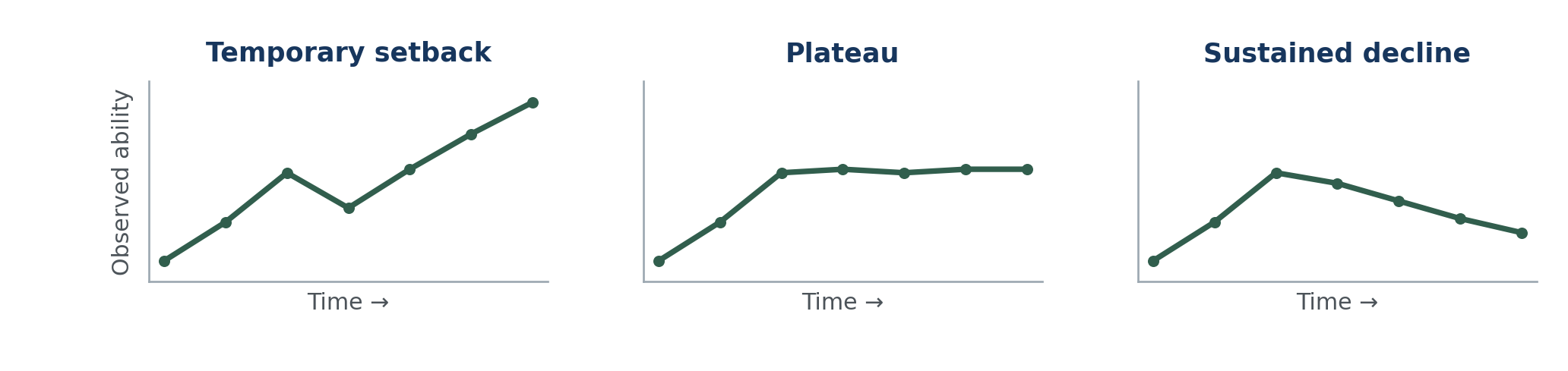
One performance tells us how we performed on that occasion. It does not necessarily tell us how much we have learnt. I would distinguish between three patterns when evaluating performance over a suitable period, under reasonably comparable conditions.
A temporary setback is a dip from which performance recovers. A plateau is a period in which there is little observable improvement. A sustained decline is a pattern of deteriorating performance. A single observation rarely tells us which pattern we are experiencing. Nor does a plateau prove that nothing is changing: the measure may simply be too limited to capture it.
This is why I question the importance sometimes given to an unbroken streak. Missing day twenty-one after twenty days of practice may reset the counter, but it does not automatically erase twenty days of learning. If practice stops for long enough, we may lose some ability. A broken streak and a loss of ability are still two different events.
Equally, I would not call every period of effort progress. If repeated observations show that our ability has not improved, we should acknowledge that. If they show a sustained decline, that deserves attention too. The point is to evaluate evidence fairly, not to manufacture a positive conclusion.
The Two Perspectives of Progress
In coaching, I would encourage a person to look at their development from both directions. Choose a goal or ability that matters to you and work through these two questions.
- How far have I come? Establish what you could actually do at the starting point. Identify what has changed, using a specific example, comparable assessment or informed feedback. If you did not record a baseline, reconstruct it honestly or establish one now.
- How far do I have left to go? Identify the standard relevant to your goal and what is still missing. Choose the next meaningful milestone that would show you have developed further, rather than simply completed more activity.
A person learning a language could record themselves explaining their daily routine, then attempt the same task a month later. They may discover that they can express more, find words more easily or recover better when they get stuck. That is evidence of change. Their next milestone might be to hold a similar conversation without preparation. They can acknowledge what they have learnt and still recognise that they are not fluent.
Use both answers, not just the one that is easiest to accept. This is a coaching-inspired reflection tool, not a scientifically validated assessment. Where formal competence or safety matters, appropriate professional assessment takes precedence. For less measurable goals, a concrete observation may be more useful than a numerical score.
Recognise the stage you have reached
A belt grading in martial arts is not an announcement that the journey is over. It is an acknowledgement of a stage the practitioner has reached. There will still be things to improve at the next training session.
Why should we deny ourselves that acknowledgement elsewhere in life? I believe we can be demanding about the quality of our work without dismissing the development that has taken place. We can recognise what we have learnt without pretending there is nothing more to learn.
Progress over perfection is not about lowering the standard. It is about refusing to make the final standard the only evidence that anything worthwhile has happened.
Before you decide that you are not good enough yet, ask yourself a different question: what can you do today that you could not do when you began?
Further reading
[1] Stoeber, J. & Otto, K. (2006). Positive conceptions of perfectionism: Approaches, evidence, challenges. Personality and Social Psychology Review, 10(4), 295–319. Read study
[2] Harkin, B., Webb, T. L., Chang, B. P. I., et al. (2016). Does monitoring goal progress promote goal attainment? A meta-analysis of the experimental evidence. Psychological Bulletin, 142(2), 198–229. Read study